Skip to content

Reference · Tools · Tracking

Everything you need to know about a peptide, and the arithmetic to go with it.

Cited compound profiles, a calculator that draws the syringe, per-milligram vendor prices, and a tracker that logs doses against the vial they came from. One account, no store, nothing for sale.

82
Cited profiles
0
Vendors priced
0
Compounds costed

Regulatory lines last checked 20 Aug 2026. We date them because in this category they change quarterly.

5 mg vial · 2 mL water · 500 mcg dose

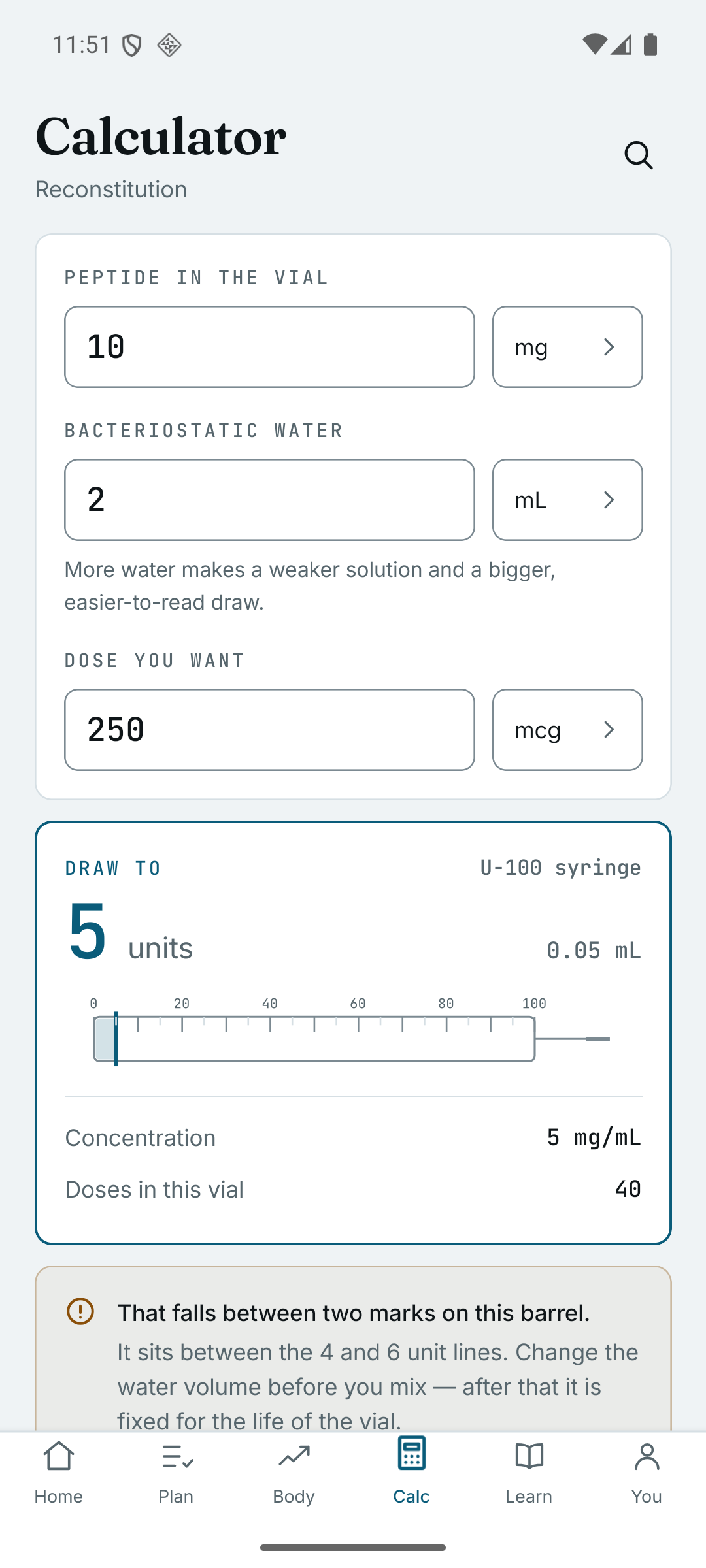
05101520253020 units0.2 mL

Draw to 20 units on a 0.3 mL U-100 syringe.

That is 0.2 mL at 2.5 mg/mL, and the vial holds 10 doses. Change any number and the barrel redraws.

The calculator does arithmetic on values you enter. It never suggests a dose.

Step one

Read

Compound profiles with mechanism in plain English, an explicit evidence level, and a regulatory line we date every time we check it.

Browse compounds
Step two

Calculate

Reconstitution and dosing arithmetic, with the answer drawn on the barrel you are actually holding. No account needed.

Open the calculator
Step three

Track

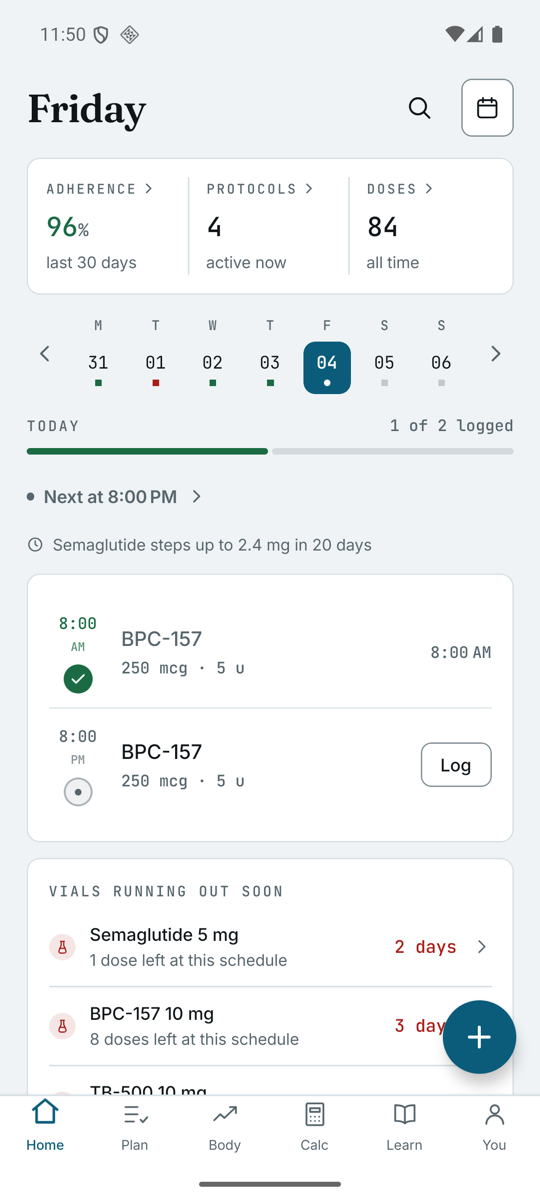
Log doses against the vial — its compound, vendor, batch and reconstitution date — rather than against an abstract compound. Publish a cycle if you want to; nothing is public unless you say so.

Start tracking
Step four

Compare

Per-milligram prices read from vendor sites and confirmed by a person, with the history to show which way they are moving.

See what things cost

Compounds

The ones people look up most

Search all 82

Semaglutide

Approved

A long-acting GLP-1 receptor agonist approved for type 2 diabetes and for weight management, dosed once weekly.

Weight loss

BPC-157

Preclinical

A synthetic 15-amino-acid peptide studied in animals for effects on tendon, ligament and gut tissue repair. No completed human trials.

Healing & recovery

Tirzepatide

Approved

A once-weekly dual agonist that activates both the GIP and GLP-1 receptors, approved for type 2 diabetes and for weight management.

Weight loss

TB-500

Preclinical

A synthetic fragment of thymosin beta-4, a naturally occurring protein involved in cell migration and tissue repair. Animal evidence only.

Healing & recovery

Retatrutide

Early human trials

An investigational once-weekly triple agonist acting on the GLP-1, GIP and glucagon receptors. Not approved anywhere.

Weight loss

CJC-1295

Early human trials

A GHRH analogue that raises growth hormone by amplifying the body's own release signal. Sold in two forms whose durations differ by two orders of magnitude.

Muscle & performance · Anti-aging & longevity

Regulatory lines last reviewed 2026-08-20. We date them because in this category they change quarterly.

Comparisons

Weighing two against each other

Semaglutide vs liraglutide

Same receptor, same drug class, one generation apart. One is a weekly injection and produced about twice the weight reduction of the other, which is a daily one.

BPC-157 vs Thymosin Beta-4

The two halves of the repair pairing, compared instead of combined. This is also where the TB-500 naming confusion does the most damage.

Ipamorelin vs GHRP-2

Two ghrelin-receptor secretagogues doing the same job. Selectivity is what separates them: one raises growth hormone and little else, the other raises several things at once.

Retatrutide vs semaglutide

One receptor against three, and a finished approval against a trial programme still running. The largest reported effect in the class, set beside the most established one.

GHK-Cu vs AHK-Cu

Two copper peptides sold for different tissue. Both carry copper, and that is why running them together is a question, not a default.

Sermorelin vs CJC-1295

Two GHRH analogues on the same receptor. How long each survives in the body is the difference, and it changes both the schedule and the shape of what comes out.

Tesamorelin vs HGH

Ask the body to release its own growth hormone, or supply it from outside. The choice decides how much say the body's own feedback still has.

5-Amino-1MQ vs MOTS-c

Two metabolic compounds approached from opposite ends: an oral small molecule that inhibits an enzyme, and a mitochondrial peptide. Almost no human data between them.

Semaglutide vs cagrilintide

Two different satiety pathways, usually discussed as a pair rather than a choice. One is an approved drug on its own; the other is mostly studied alongside it.

Epitalon vs NAD+

Two longevity compounds with problems of completely different kinds. One has a replication problem. The other has a delivery problem.

Tirzepatide vs survodutide

Two dual agonists that picked different second receptors, GIP in one case and glucagon in the other, and that sit at very different stages of evidence.

MK-677 vs HGH

An oral secretagogue against injected growth hormone. Cheaper, needle-free and indirect on one side. The hormone itself, dosed in IU, on the other.

Semaglutide vs tirzepatide

Both are once-weekly incretin agonists approved for weight management. The difference is how many receptors each one acts on, and what that does to the dosing scale.

BPC-157 vs TB-500

Two research peptides discussed for tissue repair. Both rest on animal evidence, and they differ in proposed mechanism and in dose scale.

CJC-1295 vs ipamorelin

The most compared pair in this category, and the comparison is slightly wrong-headed: they act on different receptors and are usually run together rather than chosen between.

Tesamorelin vs CJC-1295

Two GHRH analogues acting on the same receptor, separated by the largest evidence gap on this site: one completed a phase 3 programme and holds an approval, the other has neither.

MK-677 vs ipamorelin

Same receptor, opposite shapes. One is an oral small molecule producing sustained elevation; the other is an injected peptide producing a short pulse. Only one of them has a trial that was stopped early.

Tirzepatide vs retatrutide

Two and three receptors respectively. Retatrutide reported the larger weight reduction; tirzepatide has a completed phase 3 programme and an approval. This is a different kind of claim.

NAD+ vs Epitalon

Two longevity compounds with very different problems: one has a delivery problem, the other has a replication problem.

The tracking workbook

Eleven worksheets for vials, schedules, labs, storage and travel, plus a printable reconstitution guide. Free, and it imports straight into the tracker if you would rather not keep a spreadsheet.

One email with the download. We do not sell or share your address.